New Geopolitical Map in the Middle East
FreeNews.TR/New Geopolitical Map in the Middle East: Friedrich-Ebert-Stiftung’s “Sunni Diamond”, “Hexagon” and “Axis of Resistance” Analysis
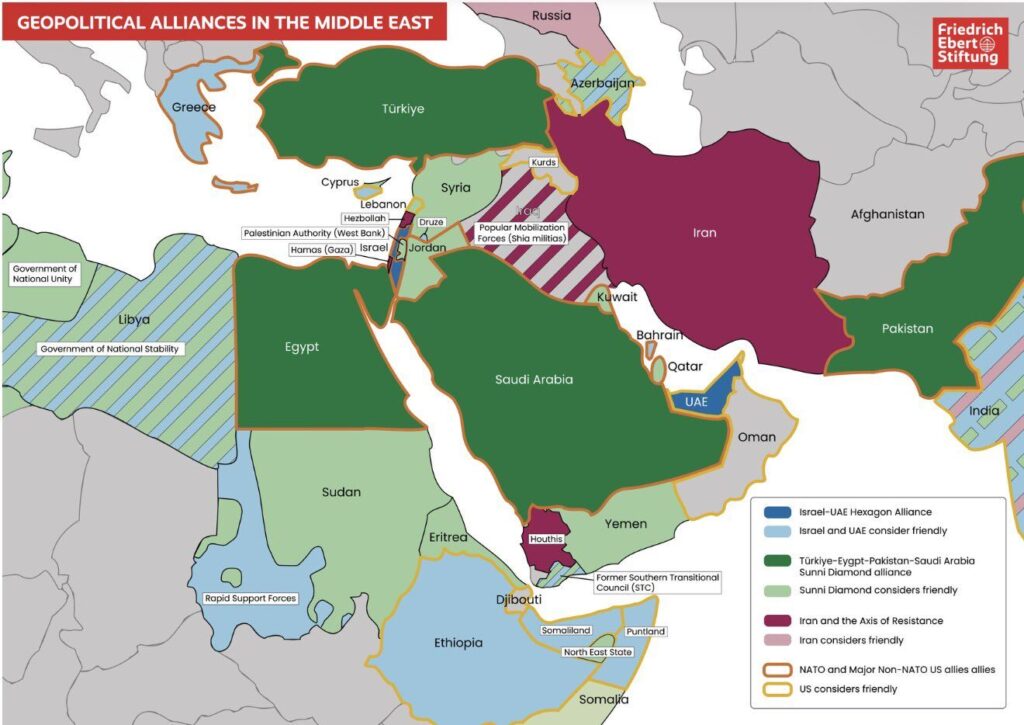
The colorful map displayed by Israeli Prime Minister Benjamin Netanyahu on screen while announcing his new national security doctrine on October 18-19, 2026, quickly sparked widespread repercussions in social media and the international press. The map had been published on May 19, 2026, by the Friedrich-Ebert-Stiftung (FES), one of Germany's oldest political foundations. Netanyahu's use of this visual nine days before the elections (October 27) brought both the map itself and the analysis behind it back to the agenda.
Source and Purpose of the Map
The map was published on the FES Asia office website under the title “Geopolitical Alliances in the Middle East”. It was prepared by Marc Saxer (head of the FES Asia-Pacific regional cooperation unit, a strategist working in geopolitics and geoeconomics) and Marcus Schneider (director of the FES Beirut-based Middle East and North Africa Regional Peace and Security Project).
FES is a political foundation close to the Social Democratic Party of Germany (SPD), operating since 1925. The organization, which works on democracy, social justice, and international cooperation, has long conducted field studies and produced policy recommendations in the Middle East.
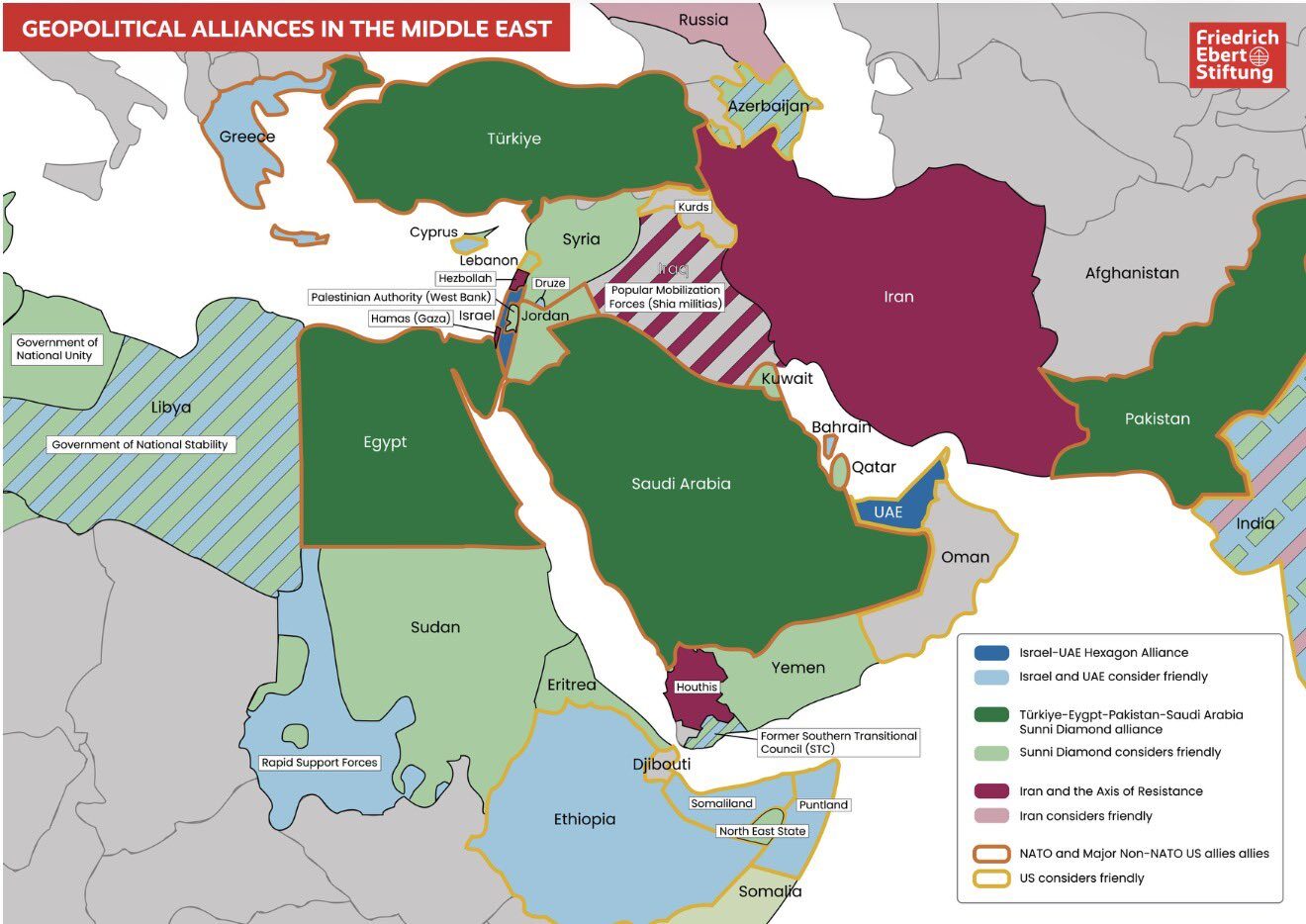
The map's main thesis is summarized in this sentence: “In the shadow of the wars leading to the reshaping of the regional order in the Middle East, new alignments are beginning to form.” The foundation argues that the public, which focuses on Iran’s “Axis of Resistance”, overlooks the less visible but potentially more decisive Israel-UAE axis and the Sunni alignment taking shape against it. The purpose is not to draw an official alliance map, but to visualize and open for discussion the fluid, competitive new regional order influenced by external actors (especially the US and China).
Three Main Blocks on the Map
The map shows three main power centers and the actors they consider "friends" using color codes:
1. Israel-UAE Hexagon Alliance (dark blue core, light blue "friendly" areas)
Its core is Israel and the United Arab Emirates. The map suggests this partnership could transform into a claim of regional superiority. The light blue areas include Greece, Ethiopia, Somaliland, Puntland, the Rapid Support Forces (RSF) in Sudan, and certain Horn of Africa actors. A similar framework was used in Netanyahu's speech.
2. Turkey-Egypt-Pakistan-Saudi Arabia “Sunni Diamond” Alliance (dark green core, light green “friendly” areas)
One of the most striking elements of the map. Turkey, Egypt, Pakistan, and Saudi Arabia are marked as the dark green core. The light green areas include Syria, Jordan, Qatar, Kuwait, parts of Sudan, Somalia, Eritrea, and specific forces in Yemen. The objective is defined as balancing both Iran's expansion and the potential "disruptive" effect of the Israel-UAE axis.
3. Iran and the Axis of Resistance (dark purple/burgundy core, pink “friendly” areas)
Iran, Hezbollah in Lebanon, the Houthis in Yemen, Shia militias in Iraq (Popular Mobilization Forces), and related actors. Russia is among the actors Iran considers "friendly". Iraq is shown as fragmented, while Kurdish regions are marked as an area considered friendly by the US and relatively independent of the three main blocks.
The map also indicates NATO and major US allies with orange lines, and areas "considered friendly by the US" in shades of yellow. Actors such as the Palestinian Authority, Hamas, Druze, and Kurds are separated with specific labels.
Current Context: The Mecca Pact and Netanyahu's Usage
When the map was published in May 2026, the Turkey-Saudi-Pakistan triangle had not yet signed an official defense pact. In August 2026, the three countries signed the “Mecca Joint Defence Agreement” in Mecca (Makkah). The agreement includes a NATO-like clause considering an attack on one as an attack on all. In October 2026, with increasing Houthi attacks on Saudi targets, the pact was activated; Turkey and Pakistan decided to send military capabilities and support to Saudi Arabia (Turkey’s contribution remained more limited and technical/defense-focused). Egypt takes part in "regional quartet" (R4) consultations but is not yet an official member of the pact.
Although FES's May analysis did not precisely predict the August pact, it accurately read the rapprochement along the Turkey-Saudi-Pakistan-Egypt line. Marcus Schneider's subsequent articles also mention the "new Middle East quartet" and the regional autonomy that emerged with the US withdrawal.
Netanyahu's presentation on October 18 integrated the map into his own security doctrine (prioritizing preemptive strikes, buffer zones, and emphasizing less dependence on the US). The speech framed that while the Iranian axis was weakening, a Sunni alignment also posed a threat. The pre-election use of the map was criticized by the opposition as "politics of fear" and "empty slogans".
Analysis: Strengths and Limitations
Strengths:
The map presents a multipolar picture that goes beyond the classic "Shia-Sunni" or "Israeli-Arab" dilemmas of the Middle East. It makes visible the relationship networks established among middle powers (Turkey, Saudi Arabia, Egypt, Pakistan, UAE, Israel) and with external actors. Its emphasis on competition areas such as the Eastern Mediterranean, the Red Sea, and the Horn of Africa is accurate. China's mediation between Saudi Arabia and Iran and the possibility of the US shifting towards a "post-American" order are also included in the text.
Limitations and criticisms:
Classifications are the authors' assessments; they are not official alliances. Many relationships are transactional, fragile, and overlapping (past Turkey-Egypt tensions, Saudi-Iran detente, UAE's different balances, etc.).
Terms like "Sunni Diamond" or "Hexagon" are analytical abbreviations; reality on the ground is more fragmented.
Netanyahu's use turned the map into a political message. The pre-election "new threats" narrative can overshadow the analytical intent of the map.
The fact that Egypt has not officially joined the Mecca Pact shows that the dark green core on the map is not yet fully institutionalized.
From Turkey's perspective, the map highlights both Ankara's deepening defense cooperation with the Saudi-Pakistan axis and its potential to assume a balancing role against the Israel-UAE axis. However, this position also intersects with Greece-Israel relations in the Eastern Mediterranean and competition in the Horn of Africa.
Conclusion
The May 2026 map by the Friedrich-Ebert-Stiftung is a work that early on captured the effort of regional actors to establish their own security architectures along with the weakening of the US-centric order in the Middle East. The Mecca Pact in August and its activation in October largely validated the map's main thesis. Netanyahu's use of this visual during the election period demonstrates how an analytical product can transform into a political tool.
The map is not a definitive future map; it is a snapshot of a fluid, competitive, and still-forming order. As wars in the region, mediation initiatives, and the roles of major powers (US, China, Russia) change, these alignments will continue to shift. FES's work still offers a useful reference point for understanding these shifts.
More stories you might like
 Field Reports / Volunteer CorrespondentselWar Preparation and Social Explosion in EuropeRead article
 Field Reports / Volunteer CorrespondentselAnkara-Centered Idealist Vision or Israel-Azerbaijan-Axis Secular Vision for the Organization of Turkic States?Read article
 Field Reports / Volunteer CorrespondentselAnti-Houthi civilian reaction in Yemen: Women and children take to the streetsRead article
 Field Reports / Volunteer CorrespondentselMatters that will ruin MuslimsRead article
 Field Reports / Volunteer Correspondentsel“Not Israel, but Riyadh”Read article
Last updated: 19.10.2026 14:02
Follow this story
Report a correction
To submit a question or correction, sign in. If you do not have an account, you can apply through the newsroom.
To ask questions about this article, sign in.
Audio playback uses voices available on your device.
Share this article
One share helps more people hear the story.
New Geopolitical Map in the Middle East
FreeNews.TR/New Geopolitical Map in the Middle East: Friedrich-Ebert-Stiftung’s “Sunni Diamond”, “Hexagon” and “Axis of Resistance” Analysis
freenews.trFor TikTok, YouTube, Snapchat, Messenger, Signal, Discord and Mastodon, copy the text and add the image manually. Your device’s share menu lists only supported apps.
This button does not publish posts or videos automatically. Download the image and share it with the text and link below.
Download the image, copy the caption and add both to a new Instagram post. If Instagram appears in your phone’s share menu, you can select it.
1080 × 1350 pixels. Captions may not be transferred automatically. Copy the text and paste it into the description; add the article link to your profile or story.
WhatsApp formats the title in bold and separates paragraphs. The receiving platform creates the link preview; no image file is attached automatically. To share an image, download the card and copy the text.
Tags: East, Geopolitical, Map, Middle, New
Leave a Reply