Secularism or the Right to Education? Baku’s New Regulation Causes Outrage
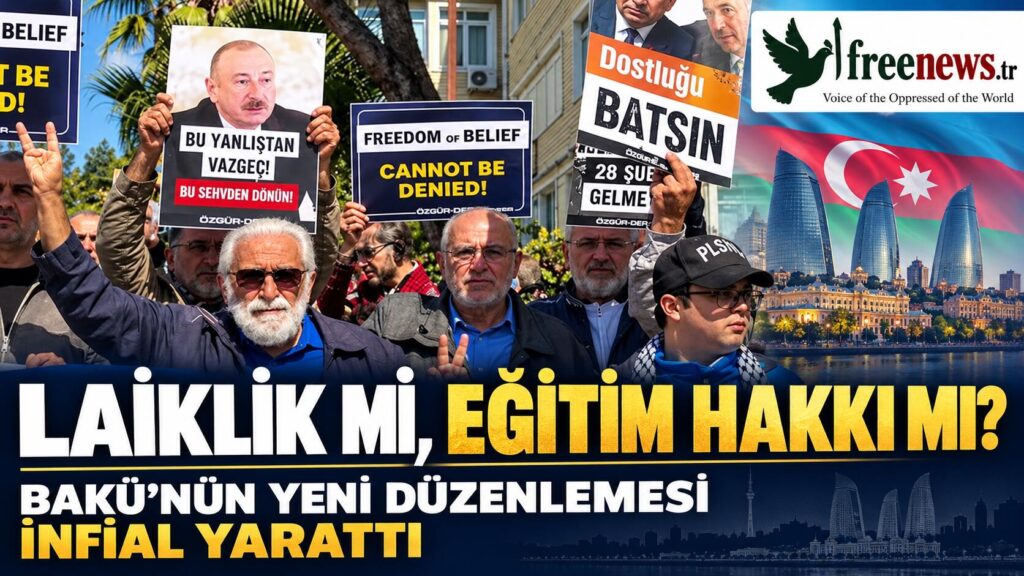
School Dress Code Regulation in Azerbaijan: Emphasis on Secularism, Headscarf Practices, Local Outrage, and Turkey-X Echoes
The principle of "national identity and secularism" added to the general education system in Azerbaijan starting from the summer of 2026 has reshaped dress codes in public schools. Although the official texts do not contain the words "headscarf" or "hijab," the provision prohibiting additional clothing items that disrupt the integrity of the school uniform and do not comply with the secularism principle of general education has led to practical obstacles for headscarfed students and teachers. While this situation has sparked student protests, reactions from Karabakh veterans, and widespread public outrage in the country, it also caused great resonance in Turkey within the framework of the "brotherly country" rhetoric and became the subject of intense discussions on the X platform.
Process: From Law to Decree
The process began in July 2026. With the legislative amendment signed by President Ilham Aliyev on July 7, 2026, the principle of "national identity and secularism" was added to the Law on General Education. It became mandatory for students, teachers, and parents in public schools to comply with clothing requirements.
On September 21, 2026, Cabinet of Ministers Decree No. 309, signed by Prime Minister Ali Asadov, regulated student attire. The decree stated that the use of other clothing items that disrupt the integrity of the designated school uniform or "do not comply with the secularism principle of general education" would not be permitted. An exception for traditional national attire was granted for cultural events. The official text did not explicitly ban the headscarf; however, in Azerbaijani media and public opinion, this provision was interpreted as a restriction encompassing religious headscarves that do not conform to the uniform. Agencies such as APA and Report avoided using the phrase "headscarf ban."
On October 6, 2026, with Decree No. 325, the regulation was extended to teachers. A requirement was introduced stating that educators' clothing items must comply with the secularism principle of general education. School administrations and pedagogical boards were granted inspection authority. The decree was evaluated as an institutional-scale expansion of the practice that had begun with students.
Prior to this, starting from March 2026, there were claims that headscarfed students were being turned away in certain schools (Baku, Sumgait, Mehdiabad, Jalilabad, Imishli). Decree No. 309 was interpreted as providing a legal basis for these practices.
Local Reactions and Outrage: Students, Veterans, and Teachers
The implementation quickly turned into a public backlash. Footage showing headscarfed female students being turned away at the gates of Full Secondary School No. 6 in Sumgait and walking away in tears was circulated on social media. Similar incidents were reported in Baku and other provinces. Claims also emerged that in some schools, the practice was withdrawn following reactions from parents.
Students did not remain silent. Students at School No. 69 in Baku and B. Shiriyev Secondary School in Mollaoba village of Masalli boycotted classes, demanding that their headscarfed friends be allowed into school. Protests with banners and chants of "hijab, hijab" circulated on social media. Children such as Khadija, the daughter of a Karabakh martyr, raised their voices through videos, saying, "The hijab is my pride, it does not hinder my education."
The most striking reaction came from Karabakh veterans. A veteran who lost his arm in the Second Karabakh War published a video showing his prosthetic arm: "I sacrificed this arm for the sake of the homeland. Long live the homeland! But my daughter won't be able to go to school because she wears a headscarf. Our blood was not shed so that our children would be left in tears." Veterans, families of martyrs, and civil society argued that the regulation violates freedom of religion and conscience and the right to education, and undermines social peace. Teacher Zahra Hasanova explained in tears that while there was no official decree, the de facto obstruction continued.
Imprisoned journalist Polad Aslanov went on a hunger strike, announcing that he was striking to defend the rights of his own child and of headscarfed students and teachers. Theologian Abgul Suleymanov received an administrative detention sentence due to his criticisms. A state television video comparing headscarfed and non-headscarfed classes further escalated the backlash. The Baku City Education Department announced that it was monitoring the practice. While the constitution guarantees the right to education and freedom of conscience, secularism is also emphasized as a fundamental principle; tension is intensifying between these two areas.
Great Backlash and Diplomatic Balance in Turkey
The issue was front-paged in Turkey under headlines such as "headscarf ban in the brotherly country." Protests were organized in front of the Azerbaijani Consulate in Istanbul. Some speakers targeted Aliyev and relations with Israel, questioning the "brotherhood" rhetoric. Voices rose from AK Party and MHP circles. Istanbul MP Mustafa Yeneroglu stated that the footage wounded consciences, called on Aliyev, and asked Turkey to discuss the issue with Baku. MAZLUMDER emphasized that the restrictions violate freedom of belief and the right to education, and that similar practices in the past have deepened social polarization.
President Recep Tayyip Erdogan’s linkage of school headscarf restrictions to "attacks on women's rights" and Islamophobia during his September 2026 UN General Assembly speech was interpreted as a veiled message directed at Azerbaijan. Aliyev’s remarks regarding "no external interference in our lifestyle" were also perceived as a criticism in Ankara. However, Turkish officials stated in remarks to Middle East Eye that they would not publicly respond to Aliyev's remarks, would not interfere in Azerbaijan's internal affairs, and preferred to de-escalate the tension. Strategic energy, transportation, and military cooperation stood out as the priorities of "brother sister country" relations. Official institutions avoided written statements.
Comparisons with Turkey's February 28 process were frequently made. The sharing of support by non-headscarfed individuals drew attention. Some circles linked the issue to Azerbaijan-Israel relations.
Reactions on the X Platform
The issue went viral on X. A Karabakh veteran's video, student protests, and footage of girls turned away from school gates were shared thousands of times. Hashtags such as #hicabaazadlıq and similar tags were used. Users made comparisons such as "Banned in Muslim Azerbaijan, not in Armenia"; analogies comparing it to the "Baku version of February 28" became widespread. Some posts criticized state television's comparison video. AK Party Spokesperson Omer Celik's statement that certain groups were targeting Azerbaijan and that this had nothing to do with the government also sparked debate. The general mood was that the right to education and the rhetoric of brotherhood were being tested; support and criticism existed side by side.
Analytical Evaluation
Azerbaijan's approach parallels similar discussions in Central Asia: preserving the secular state tradition, uniform discipline, and the limits of religious expression in the public sphere. The country has one of the lowest religiosity rates among Muslim-majority societies; official policy has long regulated religious activities. However, due to ambiguity in the text, practical implementation leaves wide discretion to school administrations and reinforces allegations of rights violations.
Although the rhetoric of "one nation, two states" is strong in Turkey-Azerbaijan relations, this crisis made power dynamics, ties with Israel, and foreign policy autonomy visible. While Ankara chooses to de-escalate the tension, public outrage persists. The resolution of the issue depends on clarifying ambiguous provisions, ensuring the uninterrupted right to education, and establishing a balanced framework between freedom of conscience and secularism. The footage and the cries of veterans show that the matter has become not just a clothing issue, but a matter of social legitimacy and the perception of "brotherhood".
Last updated: 10.10.2026 10:17
Follow this story
Report a correction
To submit a question or correction, sign in. If you do not have an account, you can apply through the newsroom.
To ask questions about this article, sign in.
Audio playback uses voices available on your device.
Share this article
One share helps more people hear the story.
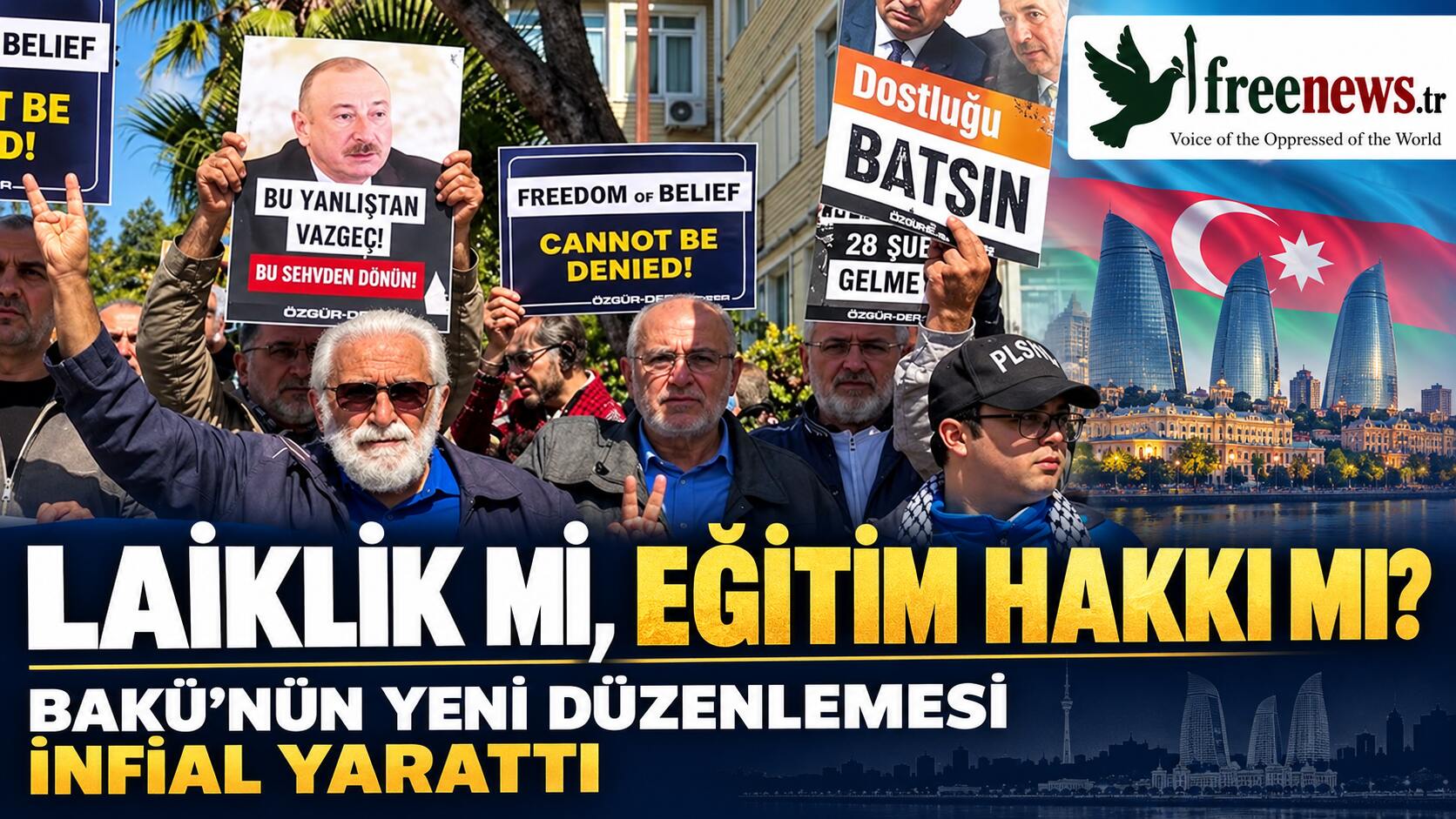
Secularism or the Right to Education? Baku’s New Regulation Causes Outrage
School Dress Code Regulation in Azerbaijan: Emphasis on Secularism, Headscarf Practices, Local Outrage, and Turkey-X Echoes
freenews.trFor TikTok, YouTube, Snapchat, Messenger, Signal, Discord and Mastodon, copy the text and add the image manually. Your device’s share menu lists only supported apps.
This button does not publish posts or videos automatically. Download the image and share it with the text and link below.
Download the image, copy the caption and add both to a new Instagram post. If Instagram appears in your phone’s share menu, you can select it.
1080 × 1350 pixels. Captions may not be transferred automatically. Copy the text and paste it into the description; add the article link to your profile or story.
WhatsApp formats the title in bold and separates paragraphs. The receiving platform creates the link preview; no image file is attached automatically. To share an image, download the card and copy the text.
Leave a Reply