
Matters that will ruin Muslims
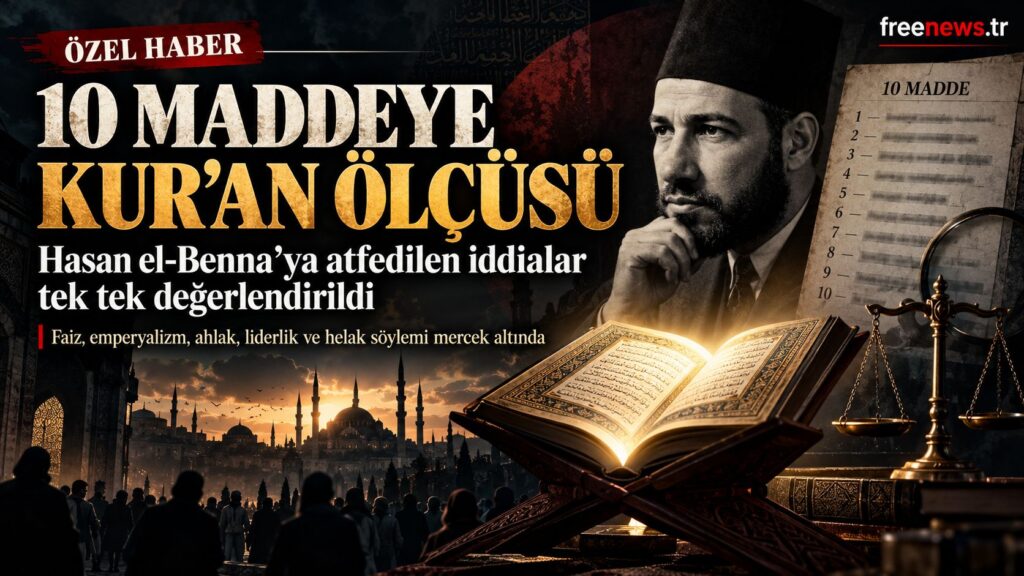
The "10 issues claimed to ruin Muslim peoples," published and attributed to the Egyptian mujahid Hasan al-Banna, are listed as: "Imperialism, personal and political disputes, sectarian divisions, usury, cooperation with Westerners, imitation of the West, man-made laws, intellectual anarchy and denial, treating everything as permissible and carnal desires, moral collapse, and the weakness of leadership and lack of a program," and it is claimed that these are being experienced today and ruin will follow.
MATTERS THAT WILL RUIN MUSLIMS
When we examine these items, which have been frequently published recently especially on social media, in the light of the Qur'an, we see that an important distinction emerges. This distinction is that a behavior being criticized in the Qur'an is one thing, while saying that that behavior will definitely ruin all Muslim peoples is another.
The criterion of the Qur'an regarding the claims in this list published in the name of Hasan al-Banna is not to entirely approve or reject the given list, but to evaluate each item separately according to the criteria of revelation. Meanwhile, the claim that the items in the list belong to Hasan al-Banna has not been verified either.
Now, if you wish, let us address the published items one by one in the light of the Qur'an:
IMPERIALISM
The Qur'an criticizes people oppressing one another and causing mischief on earth. One community crushing another, usurping their rights, and exploiting them for their own interests must also be evaluated within the framework of these principles.
"The path is only against those who oppress people and commit tyranny on earth without right." (Surah Ash-Shura, 42)
"It forbids the consumption of wealth through unjust means and the acquisition of a portion of people's wealth through sinful ways." (Surah Al-Baqarah, 188)
When we look at the issue in the light of these verses, we see that the dimensions of imperialism such as exploitation, oppression, and usurpation of rights contradict the principles of justice in the Qur'an. However, the word imperialism does not pass in the Qur'an. Which practices the concept encompasses must be evaluated through concrete behaviors, and judgment must be rendered accordingly.
PERSONAL, POLITICAL, AND SECTARIAN DISPUTES
The Qur'an speaks of the unity of Muslims and reveals that this is essential for life:
"And hold firmly to the rope of Allah all together and do not become divided." (Surah Ali 'Imran, 103)
"And do not dispute among yourselves, lest you lose courage and your strength depart." (Surah Al-Anfal, 46)
These verses clearly reveal that Muslims conflicting with each other can weaken their social strength. However, there is an important distinction here. The Qur'an does not forbid every kind of differing thought and disagreement of opinion. People having different views and turning these differences into hostility, oppression, and conflict are not the same thing. The Qur'an states in Surah Hud, verse 118, that people can differentiate.
To evaluate the issue in the light of the verses, dividing society for personal interests and turning political differences into hostility is wrong. Insulting, excluding, or oppressing people due to sectarian differences does not align with the Qur'an's principles of justice and brotherhood.
What the Qur'an criticizes is not every difference, but the contention that distances one from the truth, injustice, and factionalism that destroys unity.
USURY
The Qur'an explains usury in some verses as follows:
"Allah has permitted trade and has forbidden usury." (Surah Al-Baqarah, 275)
In Surah Al-Baqarah, verses 278 and 279, it asks to abandon usury and issues an extremely serious warning on this matter.
"O you who have believed! Fear Allah and give up what remains [due to you] of usury, if you should be believers. If you do not, then be informed of a war [against you] from Allah and His Messenger. But if you repent, you may have your principal – [thus] you do no wrong, nor are you wronged."
When we evaluate the incident in the light of the verses, usury is one of the subjects with the clearest ruling on the list. At the same time, under what conditions all financial transactions today fall under the prohibition of usury in the Qur'an must be further examined by taking into account the structure and nature of the transaction.
The spread of usury in a society leads to serious economic and moral problems. However, to claim from this that a specific society will definitely be ruined goes beyond the ruling set forth by the verses.
COOPERATION WITH WESTERNERS
This item is one of the items on the list that requires the most explanation. The Qur'an asks us to evaluate relationships with people not solely based on their identities, but based on their behaviors and attitudes.
"Allah does not forbid you from those who do not fight you because of religion and do not expel you from your homes – from being righteous toward them and acting justly toward them." (Surah Al-Mumtahanah, 8)
This verse clearly shows that justice and goodness can be taken as a basis in relations with non-Muslims.
"And cooperate in righteousness and piety, but do not cooperate in sin and aggression." (Surah Al-Ma'idah, 2)
If we evaluate the issue in the light of the verses, cooperating or trading with Westerners or other societies cannot be considered haram merely because of the identities of the parties. The real criterion is for what purpose and with what consequences the cooperation is carried out.
Islam adopts the principles "Skill is preferred over worship" and "Entrust the trusts to those who are worthy of them." Cooperation that supports justice and social benefit is not wrong merely because of the identity of the parties. Cooperation that supports oppression, aggression, or the violation of people's rights is forbidden. The criterion of the Qur'an is the nature of the cooperation rather than the identity of the party with whom cooperation is made.
IMITATION OF THE WEST
The Qur'an criticizes a person adopting the thoughts of others without questioning them. Surah Al-Baqarah, verse 170 addresses the attitude of those who follow the practices of their ancestors without questioning:
"And when it is said to them, 'Follow what Allah has revealed,' they say, 'Rather, we will follow that which we found our fathers doing.' Even though their fathers understood nothing, nor were they guided?"
Surah Al-Isra, verse 36, guides by saying, "And do not pursue that of which you have no knowledge."
This verse sets forth the principle of not acting without knowledge and responsibility.
If we evaluate the issue in the light of the verses, a thought or practice coming from the West does not mean that it is inherently wrong. Likewise, the fact that a thought is widespread in Muslim societies does not show that it is necessarily correct.
Practices in the fields of science, technology, law, education, and management must be evaluated in terms of justice, human rights, truthfulness, and other principles of the Qur'an. The Qur'an takes conscious evaluation as a basis instead of blind imitation.
MAN-MADE LAWS
This item is one of the most controversial expressions on the list.
The Qur'an addresses the subject of "judging by what Allah has revealed" between verses 44-47 of Surah Al-Ma'idah and issues extremely serious warnings within the context of the verses. However, to conclude from these verses that all laws prepared by human hands are automatically invalid or haram is an interpretation that requires further justification.
There are also provisions in the Qur'an concerning people making decisions, consulting, and judging with justice.
Surah Ash-Shura, verse 38, reports that believers conduct their affairs by consultation among themselves.
Surah An-Nisa, verse 58, commands that trusts be returned to their rightful owners and that when judging between people, judgment be made with justice.
If we evaluate the item in the light of the verses, the answers to the following questions must also be answered based on the criteria of the Qur'an:
"Does a law support justice or oppression?"
"Does it protect people's rights, or does it usurp their rights?"
"Does it contain a practice that contradicts the explicit (muhkam) rulings of the Qur'an?"
"Is it a rule suited to justice, arranged to meet the social needs of the people?"
The fact that a law was prepared by humans does not show by itself that it is unjust. The main issue from the perspective of the Qur'an is whether the law is compatible with justice and the moral principles declared by Allah.
INTELLECTUAL ANARCHY AND DENIAL
Two different concepts are brought together in this item. If intellectual anarchy is used in the sense of disorder or destructiveness in intellectual life, it must be explained concretely. Denial, on the other hand, must be evaluated according to which belief or claim is rejected.
The Qur'an invites man to think, question, and focus on evidence.
In Surah Al-Isra, verse 36, it asks man not to pursue that of which he has no knowledge.
In Surah Al-Baqarah, verse 256, it explains, "There is no compulsion in religion."
The Qur'an invites man to think and investigate the truth regarding belief. However, this does not mean that all thoughts are accepted as correct.
On the other hand, a person's lack of belief or defense of a different thought cannot be made a justification for persecuting them. The presence of freedom of thought, criticism, and different interpretations in a society is not the same thing as social destruction.
From the perspective of the Quran, the correctness of a thought must be evaluated through evidence and content; rejecting it merely because it is different is not a correct method.
SEEING EVERYTHING AS PERMISSIBLE AND ADDICTION TO LUST
The Quran criticizes people for irresponsibly following their desires. Verse 23 of Surah Al-Jathiyah brings up the situation of those who make their own desires their god and follow them. Surah Al-A'raf, verse 31, states that one should not go to extremes in eating and drinking. Surah Al-Mu'minun, verses 5-7, addresses the boundaries regarding sexual behavior.
Evaluating the subject in the light of the verses, the Quran does not consider every human desire morally correct. It asks humans to establish a balance between their desires and responsibilities. Moreover, while determining the boundaries of the halal (lawful) and haram (unlawful), the criteria set forth by the Quran—not personal opinions—must be taken as the basis. The fact that a behavior appeals to a person does not show that it is right or halal. The sole authority regarding halal and haram is the Quran.
MORAL COLLAPSE
Morality is one of the fundamental subjects of the Quran. The Quran is a book sent so that people may be moral.
"Indeed, Allah orders justice, good conduct, and giving to relatives and forbids immorality and bad conduct and oppression." (An-Nahl, 90)
Surah Al-Isra, verses 23-39, addresses many moral principles ranging from family relations to economic behavior, from the protection of human life to moderate behavior.
Examining the subject in the light of the verses, "lies, injustice, betrayal of trust, unjust gain, oppression, and violating the rights of people, etc." are among the behaviors criticized by the Quran. However, moral collapse is not limited to individual behaviors alone. The understanding of justice of administrators, institutions, and social structures is also important. When evaluating moral problems in a society, it is necessary to look not only at the behaviors of ordinary people, but also at the responsibilities of those in power and with resources, and of governments.
WEAKNESS OF LEADERSHIP AND LACK OF PROGRAM
The Quran emphasizes knowledge, competence, consultation, and justice. It does not treat those who know and those who do not know as equal, and mentions the superiority of those who know.
Surah An-Nisa, verse 58, commands that trusts be delivered to those who are competent and that people be judged with justice. Surah Al-Baqarah, verse 247, in the context of Talut's (Saul's) selection as a ruler, mentions his superiority in terms of knowledge and physical strength. Surah Ash-Shura, verse 38, highlights the principle of consultation.
When we examine the issue in terms of these verses, knowledge, merit, justice, and responsibility are important for the healthy administration of societies. The ignorance of leaders, their placing of personal interests ahead of society, or making decisions without consultation can lead to serious problems.
However, from the perspective of the Quran, good leadership is not measured solely by having a strong personality or a vast accumulation of knowledge. A leader must also be just, reliable, responsible, and competent.
WHAT DOES THE QURAN SAY REGARDING DESTRUCTION (HELAK)?
Here we can ask the following question: "How does the Quran explain the destruction of Muslim societies?"
The concept of destruction in the Quran is not always used in the same sense. While some verses describe the annihilation of past societies, other verses address the consequences of people's actions, their losses, or their moral collapses. Therefore, every social problem cannot be directly characterized as divine destruction.
Societies may face the consequences of what they do. Surah Ar-Ra'd, verse 11, states, "Indeed, Allah will not change the condition of a people until they change what is in themselves." This verse draws attention to the relationship between social change and people's own conditions. It is important for societies to correct themselves, question their behaviors, and change their wrongs.
Oppression and injustice can lead to social destruction. Surah Hud, verse 117, draws attention to the issue by stating, "And your Lord would not destroy the cities unjustly while their people were reformers." This verse also brings up the concept of reform while addressing the issue of oppression and social destruction.
Every calamity cannot be directly interpreted as divine punishment. Surah Ash-Shura, verse 30, states, "And whatever strikes you of disaster – it is for what your hands have earned," drawing attention to the relationship between some calamities that befall people and their own actions. However, moving from this verse, it is not correct to state definitively that every encountered disease, earthquake, war, or economic crisis occurs due to a specific sin. Because making definitive judgments without evidence regarding the specific meaning of an event in the sight of Allah would be overstepping bounds.
THE MOST IMPORTANT PROBLEM IN THE LIST
The fundamental problem of the ten-item list given above is that it lumps some correct determinations and controversial generalizations under the same heading.
Here we can ask another different question: "Are the problems of Muslims limited only to these 10 items?"
From the perspective of the Quran, it is not possible to reach such a conclusion. The Quran addresses injustice, oppression, unjust gain, moral corruption, betrayal of trust, arrogance, and social disruption under different headings. We cannot say that all of these items are listed in the same way in the Quran or that these ten issues definitively determine the destruction of Muslim peoples. More importantly, while evaluating such lists, the behaviors and actions of individuals or communities—not their religious identities—should be taken as the basis.
The presence of interest (usury), political conflicts, or moral problems in a Muslim society does not mean that that society will necessarily be destroyed. The Quran asks for wrongs to be corrected, justice to be established, and people to reform themselves, and expects believers to fulfill this.
The fundamental criterion set forth by the Quran is this:
"We cannot evaluate the salvation of a society solely through slogans, political affiliations, or allegiance to certain groups. Justice, righteousness, responsibility, goodness, and staying away from oppression are among the fundamental criteria."
For this reason, it is more accurate to evaluate the list published above—attributed to Hasan al-Banna—not as an immutable and complete list of destruction by the Quran, but as a body of claims in which we must question each item separately.
The thoughts I have tried to explain since above are interpretations outside of the verse texts themselves. Interpretations are correct and accurate to the extent that they match the verses. They bind no one other than the person making the interpretation and do not force anyone to believe. Because Islam wants people to think, question, and use their intellect. The most important feature that distinguishes man from angels and animals is his use of reason and free will.
Last updated: 12.10.2026 14:44
Follow this story
Report a correction
To submit a question or correction, sign in. If you do not have an account, you can apply through the newsroom.
To ask questions about this article, sign in.
Audio playback uses voices available on your device.
Share this article
One share helps more people hear the story.
Matters that will ruin Muslims
The "10 issues claimed to ruin Muslim peoples," published and attributed to the Egyptian mujahid Hasan al-Banna, are listed as: "Imperialism, personal and political disputes, secta…
freenews.tr · Selim Çoraklı - Gazeteci / Araştırmacı YazarFor TikTok, YouTube, Snapchat, Messenger, Signal, Discord and Mastodon, copy the text and add the image manually. Your device’s share menu lists only supported apps.
This button does not publish posts or videos automatically. Download the image and share it with the text and link below.
Download the image, copy the caption and add both to a new Instagram post. If Instagram appears in your phone’s share menu, you can select it.
1080 × 1350 pixels. Captions may not be transferred automatically. Copy the text and paste it into the description; add the article link to your profile or story.
WhatsApp formats the title in bold and separates paragraphs. The receiving platform creates the link preview; no image file is attached automatically. To share an image, download the card and copy the text.
Tags: Matters, Muslims, ruin, that, will
Leave a Reply