The world is bigger than five
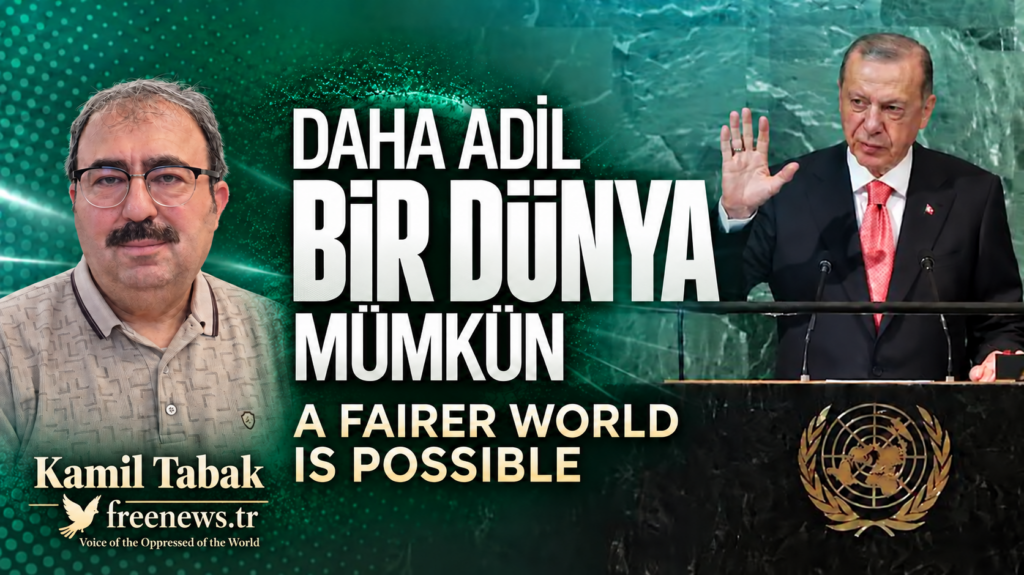
Freenews.tr/ Kamil Tabak
From a Single Sentence to a New Covenant for Humanity
The UN was born in 1945 from the ruins of the Second World War.
Its motto (the expression of its founding ideal) was a single sentence: To save succeeding generations from the scourge of war.
However, as the United Nations gathered this year for its 81st General Assembly, the world was further than ever from its promise of peace.
Although the theme of this year’s summit—held while the world is on the brink of a multi-headed global disaster—was “Rebuilding trust and reigniting global solidarity: Accelerating action on the 2030 Agenda for Sustainable Development towards peace, prosperity, progress and sustainability for all,” global trust has already been shattered.
The US-backed Israeli genocide in Gaza, ongoing massacres, the occupation spilling over into Lebanon, the controlled war between Iran and the US, the oil tension locking down the Strait of Hormuz on the Tehran-Washington line, the global energy problem triggered by rising oil prices, “conventional war with Russia” scenarios voiced in European capitals, the statements by the Iran-backed paramilitary group Houthis in Yemen that will drag the region into war, and crises and conflicts in many geographies of the world…
The world is going through a period where not only numerous crises, but also numerous insecurities intersect.
Amidst such chaos, humanity is in search of a more reasonable, fairer, more rational and more realistic mind, a political intellect, a language.
Precisely at this point, a sentence repeated for years at the UN rostrum comes before us once again:
“The world is bigger than five.”
This sentence should be read today not merely as a slogan, but as a question directed at the legitimacy of the international order.
The phrase “The world is bigger than five,” first voiced by our President Recep Tayyip Erdoğan at the UN rostrum in 2014 and repeated at every UN meeting in the following years, strengthens its meaning and importance a little more with each passing year in terms of providing the codes of this search.
However, the intellectual scope of this sentence is not limited solely to the seat distribution of the UN Security Council.
The real question is this:
To what extent can the authority to decide on the common future of humanity be concentrated in a few power centers?
And an even more important question:
Are power and legitimacy the same thing?!
So, what does the phrase “The world is bigger than five” mean?
From “What do I care about America” to “The world is bigger than five,” there is a strong tradition of discourse in Turkey’s political memory, albeit rarely, shaped around the issue of external tutelage and independence.
In the 90s, the late Necmettin Erbakan said “What do I care about America” addressing the opposition parties from the rostrum of the Grand National Assembly of Turkey regarding the termination of federated state negotiations on Cyprus.
Although this remark was perceived merely as an objection to America, it can be evaluated as the political expression of Turkey’s claim to make its own decisions with its own will.
Years later, the phrase “The world is bigger than five,” which Recep Tayyip Erdoğan first engraved in minds by saying “A world locked between the lips of 5 permanent members cannot be fair. The world is bigger than five” at the opening of the Asia-Pacific Retail Congress held in Istanbul in 2013, and later voiced in the 2014 UN General Assembly and to the faces of its interlocutors at every UN General Assembly since that date; does not merely target America and is not just the ideal of an independent Turkey; it carries a much deeper meaning than that.
Erbakan’s remark “What do I care about America” was an objection that could be read largely on the axis of national independence.
Erdoğan’s remark “The world is bigger than five” carries this objection to a broader plane.
Because the issue here is not merely Turkey’s independence against any major power.
The issue is the problem of legitimacy that the concentration of power in the international system creates for all states and societies.
Therefore, it is possible to read “The world is bigger than five” as a question directed not only at Turkey, but at the structure of the global system.
This expression is the cry of the ideal of a “Fair World / A New World” against global injustice, targeting all global imperialist states from America to Russia, Britain, China, and France.
It is a rebellion against the system that leaves the world at the mercy of 5 hegemonic states, which is the modern version of the Treaty of Tordesillas (1494), signed 5 centuries ago and dividing the world between Spain and Portugal, regulating colonial competition along a specific geographical line.
It is the exposure of colonialism, which has changed form since Tordesillas, and shouting the “hypocrisy” of the West to their faces.
It is a critique of an order where a limited number of power centers are decisive over the destiny of the world.
It is the exposure of the illusion of neutrality of the UN, the Security Council, and international law, and the rejection of Global Bonapartism.
It is the sharpest and most comprehensive critique of a UN order trapped between “legality and legitimacy.”
It is a fundamental emphasis on the vision of a fair world that prioritizes Truth and justice, not might.
The issue is whether power can generate justification for itself.
Because power says: “I can do it.”
Law asks: “Do I have the right to do it?”
Morality poses a more difficult question: “Does being able to do it make it right to do it?”
Thus, the vision of a fair world begins with being able to separate these three questions.
The sentence The world is bigger than five here transforms into a new meaning as well; not just a sentence criticizing the existing system, but also a founding sentence: A “New Covenant for Humanity” among Peoples/Societies/States.
A covenant where humanity’s future will be shaped not through the competition of power centers, but through a common order of justice.
So much so that it is a covenant with references much deeper, much more meaningful, and much more transcendent than Rousseau’s social contract, Hobbes’s solution to the security problem, or Kant’s idea of perpetual peace.
“The world is bigger than five” should be read not merely as an objection to the existing distribution of power, but as a call to move humanity’s common future from power centers to human dignity, from privilege to justice, and from competition to shared responsibility.
In other words, the issue is not merely the reform of the UN and the UN Security Council.
The issue is the moral and legal position of power within the international order.
From this perspective, “The world is bigger than five” is not just a demand for reform; it is also a call to transition from a “power-centric world vision to a rights-centric world” vision.
Whether you like Erdoğan or not, whether you criticize him 24/7, agreeing with this statement of his, appreciating and congratulating him for this cry, is the most basic requirement of being fair-minded, moral, just, and discerning.
In fact, this is also a requirement of democratic and pluralistic political culture. And true intellectual maturity begins right here.
If you do this, don’t fear, you won’t become a member of the AK Party, you will merely have rendered what is due…
Last updated: 10.10.2026 14:46
Follow this story
Report a correction
To submit a question or correction, sign in. If you do not have an account, you can apply through the newsroom.
To ask questions about this article, sign in.
Audio playback uses voices available on your device.
Share this article
One share helps more people hear the story.
The world is bigger than five
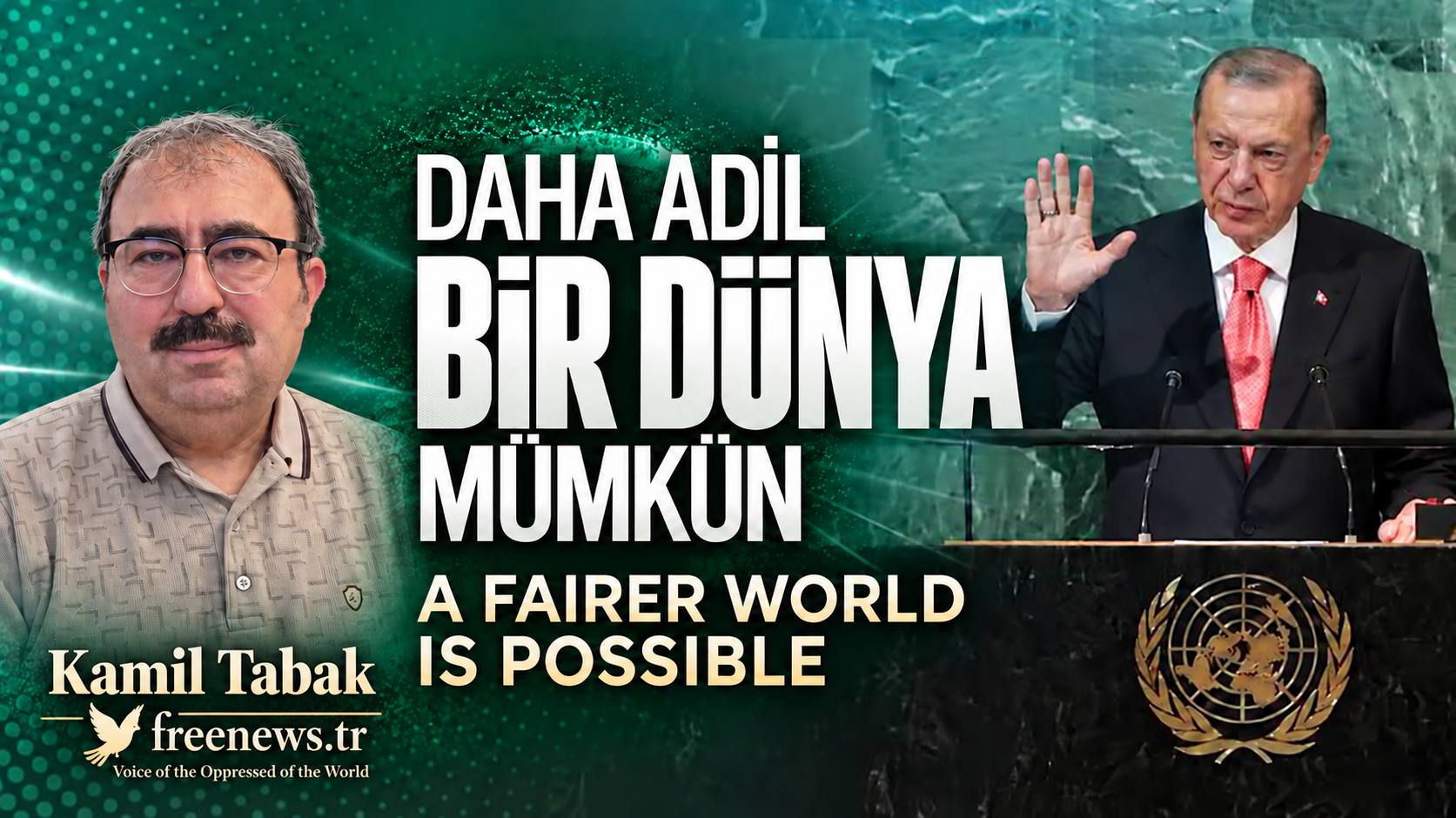
Freenews.tr/ Kamil Tabak
freenews.trFor TikTok, YouTube, Snapchat, Messenger, Signal, Discord and Mastodon, copy the text and add the image manually. Your device’s share menu lists only supported apps.
This button does not publish posts or videos automatically. Download the image and share it with the text and link below.
Download the image, copy the caption and add both to a new Instagram post. If Instagram appears in your phone’s share menu, you can select it.
1080 × 1350 pixels. Captions may not be transferred automatically. Copy the text and paste it into the description; add the article link to your profile or story.
WhatsApp formats the title in bold and separates paragraphs. The receiving platform creates the link preview; no image file is attached automatically. To share an image, download the card and copy the text.
Leave a Reply